Fig.V.1(a) shows the conventional feedback loop, which measures the distillate concentration and after comparing it with the desired setpoint, increases or decreases the reflux ratio. A feedforward control system uses a different approach. It measures the changes in the inlet feed stream (disturbance) and adjusts the reflux ratio appropriately. Fig V.1(b) shows the feedforward control configuration.
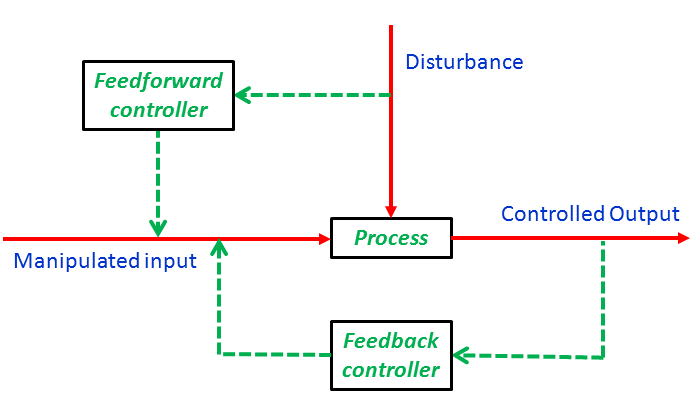
Fig V.2: The comparative schematic of feedback and feedforward control structure
Fig V.2 shows the general form of a feedforward control system. It directly measures the disturbance to the process and anticipates its effect on the process output. Eventually it alters the manipulated input in such a way that the impact of the disturbance on the process output gets eliminated. In other words, where the feedback control action starts after the disturbance is “felt” through the changes in process output, the feedforward control action starts immediately after the disturbance is “measured” directly. Hence, feedback controller acts in a compensatory manner whereas the feedforward controller acts in an anticipatory manner.
V.I.I Design of feedforward controller
Let us consider the block diagram of a process shown in Fig V.3. The Fig V.3(a) presents the open-loop diagram of the process. The process and disturbance transfer functions are represented by  and
and  respectively. The controlled output, manipulated input and the disturbance variable are indicated as
  and
and  respectively.