IV.4.3 Selection of Type of Controller (P/PI/PID)
It is worth to summarize the merits and demerits of three types of controllers before taking a decision on their selection for a particular process.
The proportional controllers accelerate the closed loop response, however it produces offset for all processes except those having integrating terms (1/s) in their transfer function. Liquid level in a tank or pressure inside a gas storage vessel demonstrates such integrators in their process models. Integral control eliminates offset but the transient of closed loop response shows higher maximum deviation from its setpoint. High gain value ensures faster response but at the cost of more oscillation, more sluggish behavior and often more tendency towards instability. Derivative action anticipates future error and takes control action apriori , however noisy response may mislead such action. Derivative action introduces a stabilizing effect on the closed loop response.
Hence, in case the system has integrating terms or if a small offset is permissible in the process operation, simple proportional controller should be employed. To ensure offset-free response, PI controller should be used. Flow controllers are mostly PI controllers. When sluggishness is observed in process response, such as temperature or concentration measurements, PID controllers can be more helpful than other two.
IV.4.4 Example of PI controller tuning using time integral performance criteria
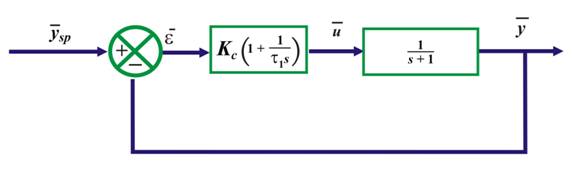
Consider the following block diagram
Fig. IV.12: Closed loop system for Example IV.4.4 |