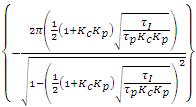
The desired decay ratio should be 0.25, hence
|
 |
|
(IV.49) |

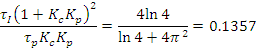
Algebraic simplification yields
 |
(IV.50) |
The above equation has two unknowns,  and
and  . We shall have infinite number solutions available which would yield one-fourth decay ratio. However, one should select the first to ensure that the controller provides the necessary strength to push the response back to the setpoint, and then one should choose an appropriate that would ensure one-fourth decay ratio.
IV.4.2 Time Integral Performance Criteria
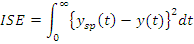
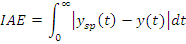
Unlike simple performance criteria where isolated characteristics (decay ratio, settling time etc.) of dynamic response are considered for controller design, time integral performance criteria considers the entire response of the process from time=0 until the steady state has been reached is considered, viz. ,
Integral of the squared error |
 |
(IV.51) |
Integral of the absolute error |
 |
(IV.52) |
Integral of the time weighted absolute error |
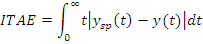 |
(IV.53) |
Best controller can be designed by selecting its parameters such that any of the above performance criteria is minimized. It is however advised to use the criteria wisely because design task essentially converts into an optimization (error minimization) problem where the integral term acts as an objective function and controller parameters as its decision variables. In case the response shows large deviation from setpoint, ISE criteria should be used because squaring of the deviation term contributes more to the cost (objective function) which eventually drags the optimization algorithm towards a set of controller parameters that ensures minimization of that cost. In case of small deviation errors (<1), squaring the term would actually reduce its contribution to the cost. Hence IAE criterion is used for such cases. When the error persists for a long time, ITAE criterion helps because the presence of time as a multiplier to the error term actually augments its effect on the cost term at high values.