Instrumentation
| As CD is simply the difference in the absorbance of the LCPL and RCPL lights, a CD spectrometer, also known as a CD spectropolarimeter, is basically an absorption spectrophotometer (Figure 8.7). The instrument has a light source, usually a Xenon lamp. The polychromatic light from the source is converted to monochromatic radiation which is further converted to linearly polarized light by a polarizer. The linearly polarized light passes through a photoelastic modulator that alternately converts the linearly polarized | 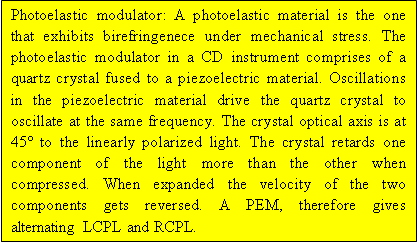 |
light into LCPL and RCPL. The LCPL and the RCPL, therefore pass through the sample alternately and their absorbance gets recorded. Absorbance is recorded at various wavelengths to obtain a CD spectrum. Single wavelength CD values are also important in studying the fast reactions such as protein folding/unfolding (discussed in the next lecture). |
|
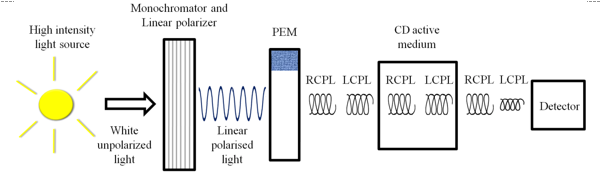
Figure 8.7 Schematic diagram of a CD spectropolarimeter.