Circular birefringence
If a sample reduces the velocity of the LCPL and RCPL to different extents, the sample is said to be circularly birefringent and the phenomenon circular birefringence. Let us see what happens when the linearly polarized light (having two components, LCPL and RCPL) traverses a circular birefringent medium: the velocities of the two components are reduced to different extents i.e. they have different wavelengths in the sample. After emerging from the samples, the wavelength is restored but two components can be out of phase. This results in the rotation of the polarization axis. If the material is not circularly dichroic, the plane of the linearly polarized light is rotated (Figure 8.6A). If the material is both circularly dichroic and birefringent, the plane polarized light will become elliptically polarized light with the major axis of the ellipse tilted with respect to the polarization axis of the incident polarized light (Figure 8.6B).
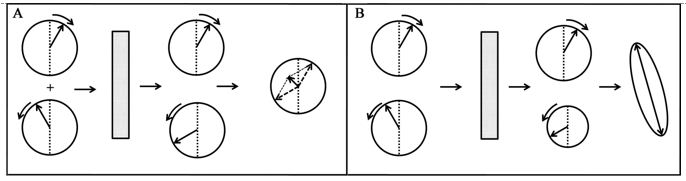
Figure 8.6 A linearly polarized light passing through a circular birefringent but not circular dichroic material (A) and through a material that is both circular birefringent and circular dichroic (B). Circular dichroism results in elliptically polarized light while circular birefringence causes change in the polarization axis.