The preferential absorption of LCPL over RCPL (or vice versa) results in elliptical polarized light (Figure 8.5).
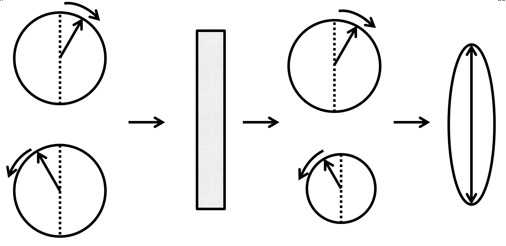
Figure 8.5 Differential absorption of the left and right circularly polarized light resulting in elliptically polarized light. Notice that if one component is completely absorbed, the resultant wave will be circularly polarized. |
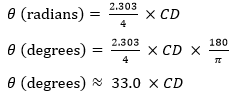
CD is historically represented in terms of ellipticity (θ) which is the tangent of ratio of minor to major axis of the ellipse. The relationship between CD and θ is give by:
|
(6.4) (6.5) (6.6) |
A plot between ∆A or ∆ε or θ against the wavelength of light represents a CD spectrum. In this lecture, we shall be discussing only electronic CD. That means that we shall be looking at the electromagnetic region that causes electronic transition, which of course is UV/Visible region.