Introduction
Before going ahead to see what circular dichroism (abbreviated as CD) means, let us have a quick revisit on the polarized light. Light, as we have discussed in lecture 3 is electromagnetic radiation where electric field and the magnetic field are always perpendicular to each other. From now on, we shall mention only electric field; it is implicit that at all points in time and space, the magnetic field vector is perpendicular to both the electric field vector and the direction of the propagation of light. Unpolarized light is comprised of several electromagnetic waves with their electric field vectors (and therefore magnetic field vectors also) pointing in all possible directions, but perpendicular to the direction of light propagation. If the vectors in all, but one, directions are cut off, the resulting radiation is a plane polarized light as the electric field vector is confined to one plane (Figure 8.1). Looking towards the light source will exhibit electric field fluctuations in one line; the plane polarized light is therefore also referred to as the linearly polarized light.
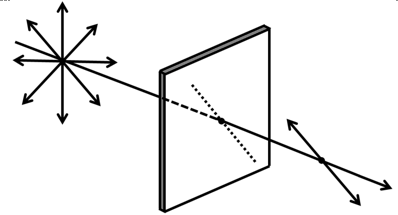
Figure 8.1 Plane polarized light produced by a linear polarizer |