Let us see what happens when the two plane polarized waves, polarized in two perpendicular planes meet each other out of phase. Suppose the two waves have a phase difference of 90°. As the two waves have same wavelength, a 90° phase difference implies that when one of the wave is at maximum amplitude, the amplitude of the other one is minimum and vice versa. If the amplitudes of the two waves are equal, their superposition with a 90° phase difference results in a wave wherein electric field vector traverses a circular path (Figure 8.3). The electric field of the resultant wave is never zero but a vector of constant length. When looked at the travelling wave from the direction of propagation, the electric field appears to be rotating in a circle. The resulting light is therefore termed as circularly polarized light (Figure 8.3).
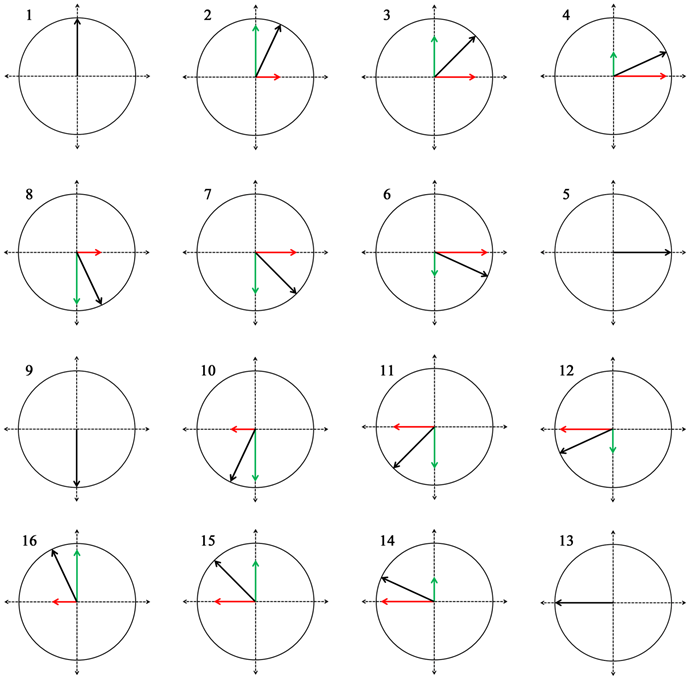
Figure 8.3 Superposition of waves linearly polarized in mutually perpendicular plain and that meet together 90° out of phase. |