The direction of rotation depends on phase difference; a -90° phase difference would result in a circularly polarized light where the electric field rotates in opposite direction. When looked towards the light source, the electric field vector of a right circularly polarized wave appears to rotate counterclockwise in space while that of a left circularly polarized wave rotates clockwise. What happens when the right circularly polarized light (RCPL) and the left circularly polarized light (LCPL) superpose? The resultant wave is a linearly polarized wave (Figure 8.4). A linearly polarized light can therefore be considered as being composed of a right circularly polarized light and a left circularly polarized light.
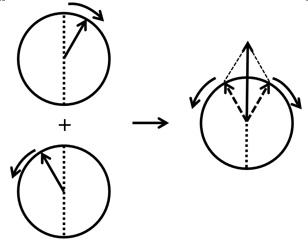
Figure 8.4 Superposition of left and right circularly polarized light resulting in plane polarized light. |
Circular Dichroism
Circular dichroism, abbreviated as CD, is a chiroptical spectroscopic method. A chiral molecule or an achiral molecule in asymmetric environment interacts differently with the LCPL and the RCPL. The literal meaning of dichroism is ‘two colors’. In chiroptical spectroscopy, dichroism means differential absorption of the lights with different polarizations. Circular dichroism, therefore, refers to the differential absorption of the left and right circularly polarized light and is defined as:
|
(6.1) |
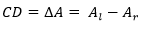
where, Al and Ar are the absorbances for the left and right circularly polarized lights, respectively.
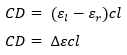
We can therefore say that the molar absorption coefficients for the two lights are different and can write the equation 6.1 can be written as:
|
(6.2) |