Tandem mass spectrometry
Tandem mass spectrometry (also known as MS/MS) involves more than one mass analyzer. As we have just seen, incorporating more than one mass analyzer greatly enhances the capabilities of a mass spectrometer. Furthermore, it improves the sensitivity, mass resolution, and the mass accuracy of the spectrometer. The most common MS/MS experiment involves selecting an ion using first mass analyzer, which is then fragmented into daughter ions in a collision cell. The daughter ions are then detected by a second analyzer. It is possible to further fragment the daughter ions into granddaughter ions that are then analyzed by a third mass analyzer. It is in principle possible to do an MSn experiment. We shall see in the next lecture how powerful tandem mass spectrometry is in identifying and characterizing the biomolecules.
Detectors
A variety of ion detectors presently exist, some of which are:
Electron multiplier: An electron multiplier is perhaps the most commonly used ion detector in mass spectrometers. It consists of a series of electrodes (dynodes). When an ion strikes the first dynode, it causes release of electrons from the dynode (the first dynode, therefore is a conversion dynode that converts the ion signal into electrons) that strike the second dynode releasing more electrons and so on. This cascading effect causes a large amplification in the electrical current (Figure 12.8A). Another design of the electron multiplier uses a continuous dynode (12.8B).
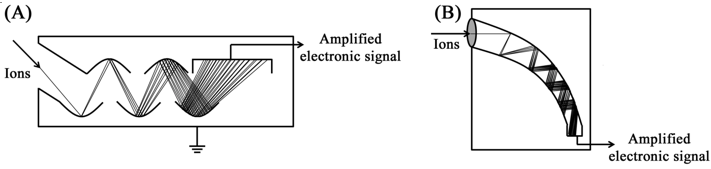
Figure 12.8 A diagrammatic representation of current amplification in an electron multiplier