Magnetic sector
Figure 12.1 shows a diagram of the magnetic sector analyzer mass spectrometer. The ions (say, cations) generated in the ionization chamber are accelerated under a strong electric field. The accelerated ions are allowed to pass through a narrow slit resulting in a sharply focused ion beam. The ions in the beam can be deflected by applying a magnetic field perpendicular to the velocity of the ions.
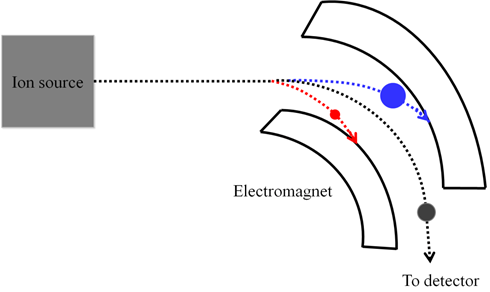
Figure 12.1 Diagram of a magnetic sector mass analyzer. |
Too small (blue dotted line, Figure 12.1) or too much deflection (red dotted line, Figure 12.1), which is determined by the charge and the momentum of the ions (Equation 11.8), causes the ions to collide with the MS tube. Therefore, the ions within a small  range will be allowed to go to the detector.It is
possible to sequentially allow all the ionic species to reach the detector by gradually varying the magnetic field. Assume that the magnetic field strength is zero initially. All the ions will move straight (Equation 11.8) and collide with the curved MS tube losing their charge. If the magnetic field is slowly increased from zero to the maximum value, the ions with lowest momentum and highest charge will appear first while the ions with highest momentum and lowest charge will appear last.
Time of flight (TOF)
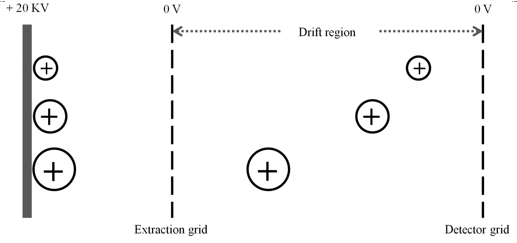
In a time of flight mass analyzer, the time taken by the ions to reach the detector is measured. The ions are generated in bundles e.g. by MALDI. The ions are then accelerated towards the flight tube. The flight tube does not have any electric field and the ions drift in the flight tube according to their velocities (Figure 12.2).
|
Figure 12.2 Separation of the ions in a TOF tube |