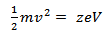
If a particle with charge, q (= ez ) and mass, m is accelerated towards the flight tube by electrostatic potential, V, the kinetic energy (KE ) of the particle can be given by:
KE=qV ................................................. |
(12.5) |
 ................................................ ................................................ |
(12.6) |
where, v is the velocity of the particle.
If, L is the length of the tube, the time taken by an ion with velocity v is given by:
 ................................................ ................................................ |
(12.7) |
Substituting the value of v from equation 12.6 into equation 12.7 gives:
 ................................................ ................................................ |
(12.8) |
Equation 12.8 shows that the time taken by the particle to reach the detector is directly proportional to  ratio. The ratio of the particle can therefore be calculated from the time of flight of the particle:
| Rearranging equation 12.8: |  ......................................... ......................................... |
(12.9) |
A serious problem with the linear TOF analyzers is their poor resolution. This happens due to difference in the flight times among the ions having same ratio. The factors responsible for the poor resolution include length of the ionization laser pulse, space distribution of the ions formed, and spread in the initial kinetic energies of the ions. In MALDI-TOF, for example, these factors severely affect the resolution. Two techniques have considerably improved the resolution in MALDI-TOF:
- Delayed extraction: In continuous extraction, the ions generated are continuously extracted towards the TOF tube. An ion with higher initial kinetic energy reaches the detector earlier than the ion with smaller initial kinetic energy. Delayed extraction improves this situation substantially. Following ionization, the ions are allowed to move in the field free region according to their kinetic energies during a short delay. An extraction pulse is then applied; the pulse gives more energy to the ions that are nearer to the ionization source as compared to those that have moved away. The ions with small initial kinetic energies, therefore gain more energy and catch up the ions moving ahead (Figure 12.3).
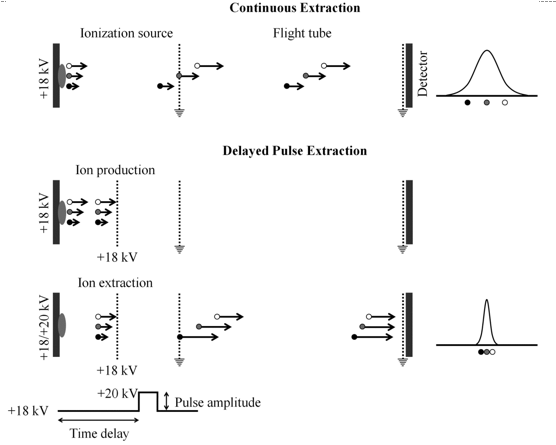
Figure 12.3 A diagrammatic representation of delayed extraction TOF