Following ionization, the gas phase ions are accelerated towards the mass analyzers. A great variety of mass analyzers are utilized in the mass spectrometers. All of these analyzers separate the molecules using static or dynamic electric fields and magnetic fields, alone or in combination. After mass analysis, the ions are detected and the mass spectra are generated.
Imagine what would happen if the ions collide with the air molecules in the MS tube. This can lead to the loss of charge to the molecules in the air, deviation in the ion trajectory which might lead to the collision with the MS tube, reactions with the air molecules, etc. A mass spectrometer, therefore operates under very high vacuum to ensure that the ions reach the detector without colliding with the air molecules. The mean free path of a particle is the average distance a particle travels before colliding with other particles and is inversely proportional to the pressure of the gas and the size of the colliding molecules. The mean free path, according to the kinetic theory of gases is given by:
 ............................................................................... ............................................................................... |
(12.1) |
where, λ is the mean free path, k is the Boltzmann constant (1.38 × 10⁻²³ JK-1), T is the temperature, d is the sum of the radii of the ion and the colliding molecule, and p is the pressure.
Let us try calculating the mean free path for a small ion in the air. We need to make a few assumptions: Air is largely nitrogen (~78%) and oxygen (~21%). The Van der Walls radii for nitrogen and oxygen are 155 pm and 152 pm, respectively. As the Van der Walls radii of oxygen and nitrogen are very close, we can assume air to be composed of a particle with ~150 pm. Let us calculate the mean free path for a small molecular ion,  (molecular radius ~380 pm). The mean free path at room temperature (T ≈ 298 K) and atmospheric pressure (1.01 × 10⁵ Pa) can be given by:
 ................................................... ................................................... |
(12.2) |
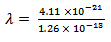 ..................................................... ..................................................... |
(12.3) |
 ..................................................... ..................................................... |
(12.4) |
In a mass spectrometer, the ions have to travel large distances (usually >1m). It is therefore absolutely essential to apply large vacuum for increasing the mean free path by several orders of magnitude. Let us now have look at some of the important mass analyzers: