- Reflectrons: A simple reflectron is composed of a series of equally spaced grids. The reflectron is placed at the tube end opposite to the ion source. A potential is applied to the reflectron so as to reflect the incoming ions. A reflectron therefore acts as an ion mirror. The ions with higher kinetic energy will travel longer distance before reflecting back than those have smaller kinetic energy. The ions with higher kinetic energy are therefore made to travel longer distances thereby correcting for the spread in the peaks (Figure 12.4).
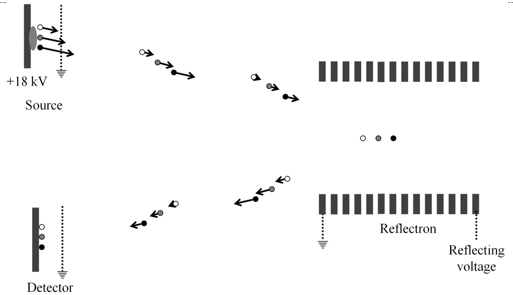 Figure 12.4 A diagrammatic representation of reflectron-mode TOF
Quadrupole analyzers
A quadrupole mass analyzer is made up of four rods arranged parallel to each other as shown in Figure 12.5. The principle of a quadrupole was proposed by Paul and Steinwegen in 1953 wherein hyperbolic cross-section of the rods was described as necessary. In practice, however, rods with circular cross section have also proved effective and have replaced the rods with hyperbolic cross-section in modern quadrupole detectors.
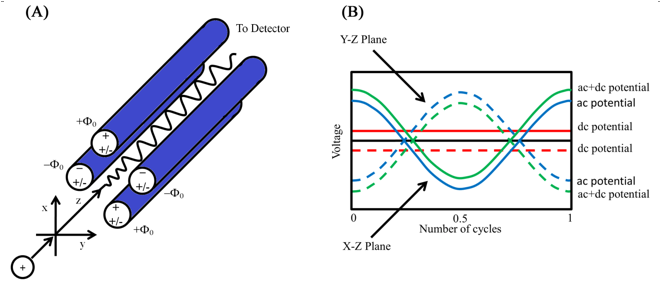
Figure 12.5 A quadrupole mass analyzer (A) and the potential on the rods as a function of time (B).