• Electroporation
In electroporation, the external electric field is applied to the protoplast, which changes the electrical conductivity and the permeability of cell membrane; and thus the exogenous molecules found in the medium are taken up to either the cytoplasm (transient transfection) or into the nucleus (stable transfection). The efficiency of electroporation can be increased by giving the cell a heat shock, prior to the application of electric field or by using small quantity of PEG while doing electroporation. See lecture 3 of module 5 for detailed explanation.
Advantage:
- By electroporation large numbers of cells can be processed at once, and thus the amount of time spent processing cells can be cut down.
Disadvantages:
- If the voltage applied is not calculated properly, the cells may damage.
- If electroporation does not occur in controlled environment, the potentially harmful substances can enter the cell or the impurities from solution may enter. This is because there is no way to control what enters the cell membrane.
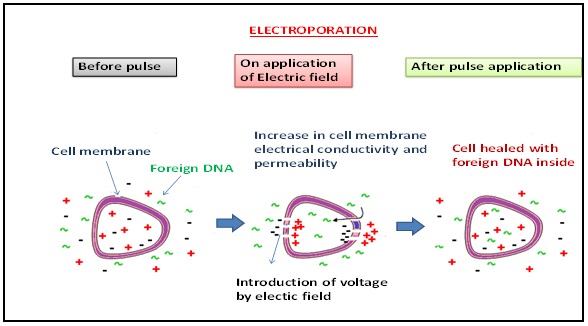
Figure 8-1.7.2.5: Electroporation