The adenoviral DNA has inverted terminal repeats (ITRs) and a terminal protein (TP) is attached covalently to 5' termini. The adenoviral genome is classified as early and late regions based on the proteins they express. Proteins encoded by early region (E1, E2, E3, E4) genes are involved in viral DNA replication, cell cycle modulation and defense system. The late region genes (L1, L2, L3, L4, L5) encodes the viral structural proteins. Three classes of adenoviral vectors namely first, second and third generation viral vectors are developed for gene therapy purpose.
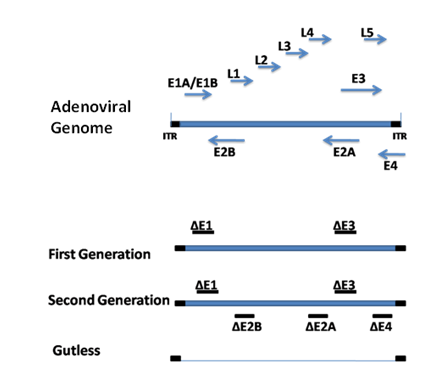
Figure 8-1.7.1.1b: Map of Adenoviral genome and construction of different types of adenoviral vectors
Adapted and Modified from: R Alba, A Bosch and M Chillon (2005). Gutless adenovirus: last-generation adenovirus for gene therapy. Gene Therapy, 12, S18-S27
First generation adenoviral Vectors
These vectors are constructed by replacing the E1/E3 expression cassette and inserting our candidate gene of 3-4kb size. E1 encodes proteins responsible for expressions of other viral genes required for viral growth. So cell lines that can provide E1 proteins in trans are required for the replication of the E1 deleted viral vectors.
Advantages:
- They are human viruses produced at very high titers in culture.
- They can infect a wide range of human cell types including non- dividing cells.
- They enter into cells by receptor mediated endocytosis with a very high transduction efficiency reaching upto 100% in vitro
- Their large size enables them to accept large inserts.
Disadvantages:
- Expression of foreign gene is for short period of time as they do not integrate into the chromosome.
- These vectors may generate immune response causing chronic inflammation.