Note: Table 8-1.7 is a dapted From AR Prabhakar in Gene Therapy and its Implications in Dentistry . International Journal of Clinical Pediatric Dentistry , 2011; 4(2):85-92
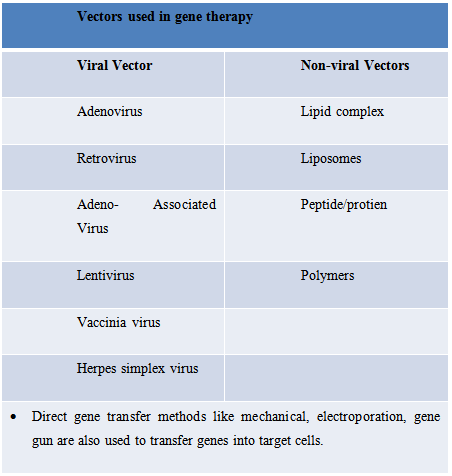
Table 8-1.7: Vectors used in gene therapy
8-1.7.1 Viral vectors
Retroviruses, adenoviruses and adeno-associated viruses (AAV) some commonly used viral vectors whereas some less commonly used viral vectors are derived from the Herpes simplex virus (HSV-1), the baculovirus etc.
• Adenoviral vectors
Adenoviruses are large linear double-stranded DNA viruses that are commonly used for preparing gene transfer vectors. Adenovirus vectors are known to be the second most popular gene delivery vector for gene therapy of various diseases like cystic fibrosis and certain types of cancer. Figure 8-1.7.1.1a shows how the adenoviruses enter cells by receptor-mediated endocytosis. A primary cellular receptor binds to viral fiber then the virus interacts with secondary receptors which are responsible for its internalization. Coxsackie and Adenovirus Receptor (CAR), Heparan sulphate glycosaminoglycans, sialic acid, CD46, CD80, CD86, alpha domain of MHC I are the primary receptors which are specific for specific strains of adenovirus. Integrins are the secondary receptors which helps in the internalization of viral particles. Some adenovirus directly interacts with integrins like in the case of fiber deficient Ad2 virions.
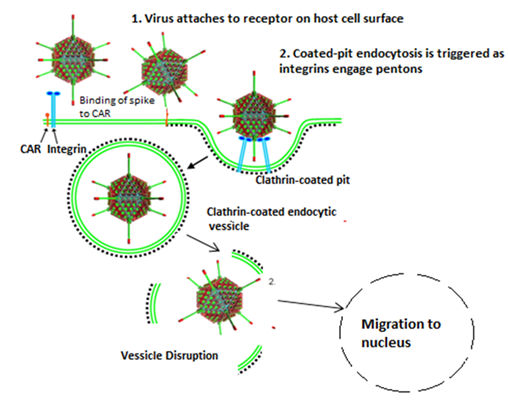
Figure 8-1.7.1.1a
Adapted and modified from :
http://www.ncbi.nlm.nih.gov/books/NBK7569/figure/A2918/?report=objectonly