• Adeno- Associated Virus (AAV)
Adeno-associated viruses (AAVs) are a group of small, single-stranded DNA viruses which cannot usually undergo productive infection without co-infection by a helper virus, such as an adenovirus.
- The insert size for AAV is 4.5 kb, with the advantage of long-term gene expression as they integrate into chromosomal DNA.
- AAVs are highly safe as the recombinant adeno associated vectors contains only gene of interest and 96% viral genes are deleted.
Adeno-associated viruses are explained in detail in Module 5-Lecture 1.
• Retroviral Vectors
Retroviruses are RNA viruses which possess a reverse transcriptase activity, enabling them to synthesize a complementary DNA. Following infection (transduction), retroviruses deliver a nucleoprotein complex (pre-integration complex) into the cytoplasm of infected cells. The viral RNA genome is reverse transcribed first and then integrates into a single site of the chromosome.
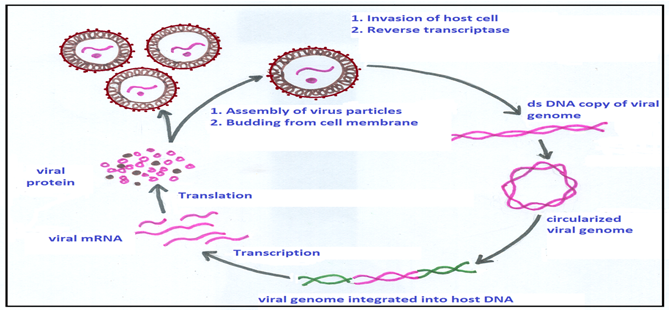
Figure 8-1.6.1.1c
Adaptedand modified from:
http://www.ncbi.nlm.nih.gov/books/NBK7570/figure/A2357/?report=objectonly
- Tumor retroviruses, example Moloney's murine leukemia virus (MoMuLV), is widely used for the generation of recombinant vectors. these are produced at low titers as all the viral genes are deleted.
- Oncoretroviruses: The cells that divide shortly after infection can only be transduced by oncoretrovirus. The preinitiation complex is excluded and their entry is restricted in to the nucleus as they can only enter when nuclear membrane dissolves during cell division the target cells for this viral vector is limited
- Recombinant lentiviruses are being developed that are non- pathogenic to humans and have the ability to transduce stationary cells.