3-4.5 In Situ Hybridization (ISH)
It is a technique that employs a labeled complementary nucleotide strand (i.e. probe) for localizing specific DNA or RNA sequence targets within fixed tissues and cells (i.e in situ). Probes used for hybridization can be double-stranded DNA probes, single-stranded DNA probes, RNA probes, synthetic oligonucleotides. There are two ways available to detect DNA or RNA targets
Chromogenic (CISH) in situ hybridization and Fluorescence in situ hybridization (FISH).
3-4.5.1 Chromogenic in situ hybridization (CISH)
It uses the labeling reactions involving alkaline phosphatase or peroxidase reactions to visualize the sample using bright-field microscopy. It is primarily used in molecular pathology diagnostics. CISH can also be employed for samples like fixed cells or tissues, blood or bone marrow smears and metaphase chromosome spreads.
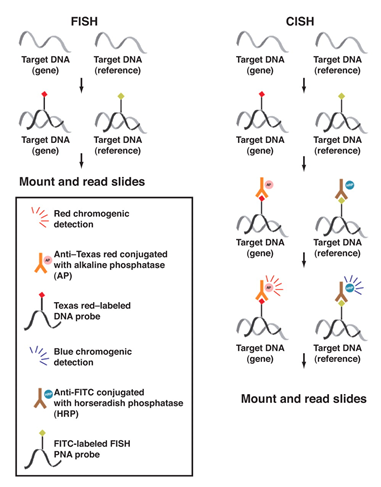 |
Fig.3-4.5.1: Use of dual-color Chromogenic in situ hybridization (CISH) in combination with fluorescence in situ hybridization (FISH) probes. FITC, fluorescein isothiocyanate; PNA, peptide nucleic acid. (Obtained from http://ajcp.ascpjournals.org/content/133 /2/205/F1.expansion.html) |