3-4.3.3 Applications:
Northern blotting helps in studying gene expression pattern of various tissues, organs, developmental stages, pathogen infection, and also over the course of treatment. It has been employed to study overexpression of oncogenes and down-regulation of tumor-suppressor genes in cancerous cells on comparison with healthy tissue, and also for gene expression of immune-rejection of transplanted organ.
The examination of the patterns of gene expressions obtained under given conditions can help determine the function of that gene.
Northern blotting is also used for the analysis of alternate spliced products of same gene or repetitive sequence motif by investigating the various sized RNA of the gene. This is done when only probe type with variation in one location is used to bind to the target RNA molecule.
Variations in size of a gene product may also help to identify deletions or errors in transcript processing, by altering the probe target that can be used along the known sequence and make it possible to determine the missing region of the RNA.
3-4.4 Colony Hybridization:
It is a rapid method of isolating a colony containing a plasmid harboring a particular sequence or a gene from a mixed population. The colonies to be screened are first replica-plated on to a nitrocellulose filter disc that has been placed on the surface of an agar plate prior to inoculation. Master plate is retained for reference set of colonies. The filter bearing the colonies is removed and treated with alkali so that the bacterial colonies are lysed and the DNA they contain is denatured. The filter is then treated with proteinase K to remove protein and leave denatured DNA bound to the nitrocellulose. The DNA is fixed firmly by baking the filter at 80°C. A labeled probe is hybridized to this DNA which is monitored by autoradiography. A colony whose DNA print gives a positive auto radiographic result on X-ray film can then be picked from the reference plate.
Colony hybridization can be used to screen plasmid or cosmid based libraries.
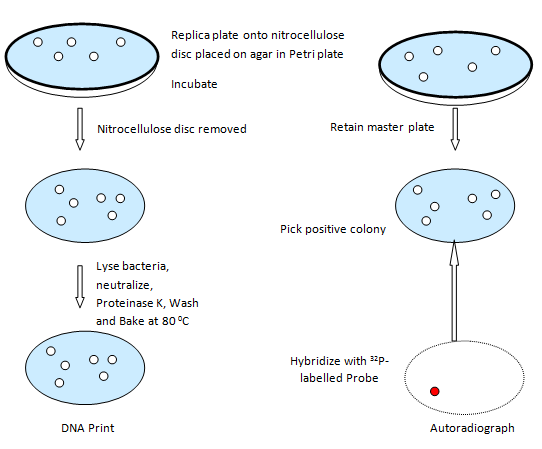
Fig 3-4.4: Colony hybridization