The seven major classes of cell surface receptors are:
- G protein-coupled receptors
- Cytokine receptors
- Receptor tyrosine kinases
- TGFβ receptors
- Hedgehog receptors
- Wnt receptors
- Notch receptor
Structure of Seven helix receptors: Membrane bound receptors constitute the members of the largest family of plasma membrane receptors built from a serpentine arrangement of seven transmembrane α helices. G protein–coupled receptors (GPCRs) are examples of seven transmembrane α helices receptors. GPCRs are found in all eukaryotic cells from yeast to man. All G protein–coupled receptors contain seven membrane-spanning regions with their N-terminal segment on the exoplasmic face and their C-terminal segment on the cytosolic face of the plasma membrane.
As shown in Figure 6 (a), all receptors of this type have the same orientation in the membrane and contain seven transmembrane - helical regions (H1–H7) - four extracellular segments (E1–E4), and four cytosolic segments (C1–C4). The carboxyl-terminal segment (C4), the C3 loops and, in some receptors, also the C2 loops are involved in interactions with a coupled trimeric G protein. The long C3 loop between helices 5 and 6 is important for interactions between a receptor and its coupled G protein. This superfamily of seven-pass transmembrane receptor proteins includes rhodopsin, the light-activated protein in the vertebrate eye as shown in Figure 6 (b).
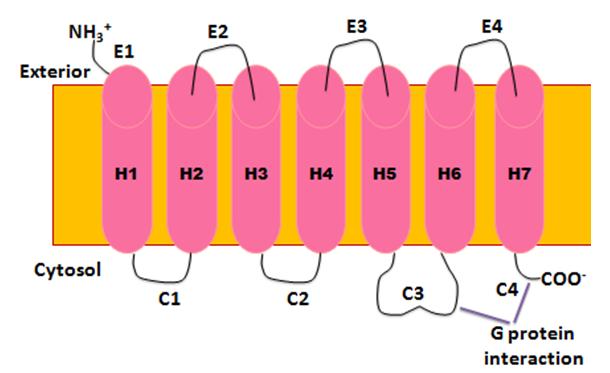
Figure 6 (a): Schematic diagram of G protein–coupled receptors
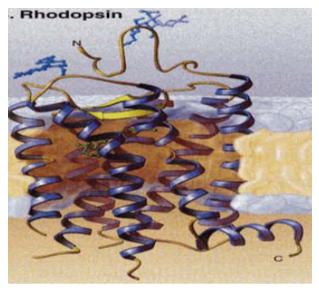
Figure 6 (b): Atomic structure of seven helix receptor of bovine rhodopsin, the light activated protein in vertebrate eye