Receptor:
A receptor is a protein molecule found on the surface of a cell which receives chemical signals originating externally from the cell. Binding of specific signalling molecules to a receptor directs a cell to allow certain molecules to enter or exit or directs a cell to divide or die. Cells within multicellular organisms communicate via extracellular mediators: either through diffusible molecules or by direct cell–cell contact. Examples of receptors are G-Protein coupled receptors, Cytokine receptors as shown in Figure 1.
Receptors are located in either the cytoplasm or plasma membrane or nucleus of a cell. A molecule which binds specifically to a receptor is called a ligand . A ligand may be a peptide or other small molecule s, such as a hormone , a neurotransmitter , a pharmaceutical drug or a toxin. Each type of receptor recognizes and binds only certain ligand shapes. Binding of a ligand to its receptor causes a conformational change in the cytosolic domain of the receptor which then triggers the subsequent signalling cascade; i.e. it activates or inhibits a specific biochemical pathway. Ligand-induced changes in receptors result in cellular changes which constitute the biological activity of the ligands. Most signalling molecules bind to receptors expressed on the target cell surface but some signalling molecules are able to cross the plasma membrane and bind to intracellular receptors in the cytoplasm or nucleus.
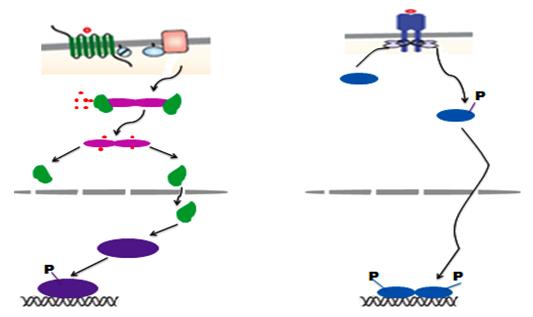
G protein-coupled receptor Cytokine receptor
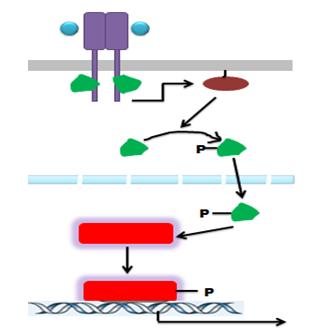
Receptor tyrosine kinases
Figure 1: Examples of receptors