Auxin signaling: Auxin binds to a receptor with ubiquitin ligase activity. This stimulates ubiquitination and degradation of a specific transcriptional repressor further leading to transcription of auxin-induced genes as shown in Figure 4.
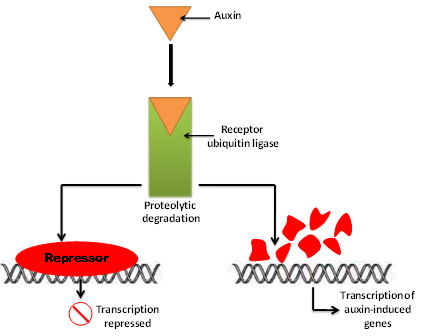
Figure 4: Auxin signaling
Functions of Auxin: Indole acetic acid regulates many responses: Cell elongation and wall relaxation and cell differentiation. It promotes differentiation of vascular tissue (i.e., xylem & phloem). IAA apparently stimulates the production of ethylene. IAA at more than 10-6 M concentration inhibits root elongation. However, very low concentration (>10-8 M) favor root elongation. It stimulate root initiation both lateral roots and adventitious roots. Most plants do not initiate the production of flowers after auxin treatment except pineapple and its relatives belonging to Bromeliaceae. Once flowers are initiated, in many species, IAA promotes the formation of female flowers, especially in cucurbits (gourd family). Parthenocarpic fruit development is regulated by auxins. The apical meristem (apex) controls or dominates the development of the lateral buds. Apical dominance also occurs in roots. Auxin mediates the tropistic (bending) response of shoots and roots to gravity and light. It delays leaf senescence. Auxin may inhibit or promote (via ethylene) leaf and fruit abscission.