Discovery of auxin: Darwin (1881) was the first person who discovered the existence of auxin in plants, the first phytohormone known. He noted that the first leaf (coleoptile) of canary grass (Phalaris canariensis) was very sensitive and responsive to light and he demonstrated the bending of the grass coleoptiles towards unilateral source of light. This bending occurred only when the coleoptile was also illuminated. When the tip of the coleoptiles was covered with a black cap, it resulted in loss of sensitivity of the plant towards the light as shown in Figure 2. Darwin concluded that some influence that causes curvature is transmitted from the coleoptile tip to the rest of the shoot. Boysen – Jensen (1913) also made similar observations on oat (Avena) coleoptiles as shown in Figure 2. Paal (1918) demonstrated that when the decapitated coleoptiles tip was replaced on the cut end eccentrically, more growth resulted on the side which causes bending even when this is done in complete darkness.
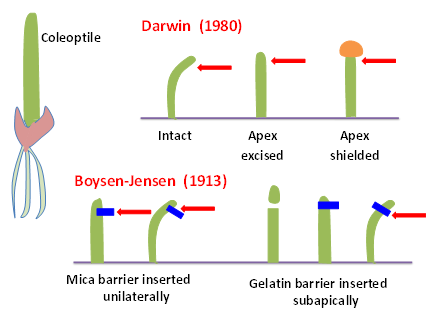
Figure 2: Discovery of auxin: phototropic response of grass seedlings
Sites of biosynthesis of auxin: IAA is synthesized primarily in actively growing tissue in leaf primordia and young leaves, fruits, shoot apex and in developing seeds. It is made in the cytosol of cells.
Tryptophan-dependent Pathways for auxin synthesis: Tryptophan, one of the protein amino acids, is the precursor of auxin biosynthesis. The conversion of tryptophan to Indole Acetic Acid can occur by either transamination followed by a decarboxylation or decarboxylation followed by a transamination. Formation of IAA via an oxime (C=NOH) and nitrile (CN) is shown in Figure 3.