Steps in exocytosis:
Vesicles are used to transport the proteins from the Golgi apparatus to the cell surface area using motor proteins and a cytoskeletal track to get closer to cell membrane. Once these vesicles reach their targets, they come into contact with tethering factors that can restrain them. Then the process of vesicle tethering distinguishes between the initial, loose tethering of vesicles from the more stable, packing interactions. Tethering involves links over distances of more than about half the diameter of a vesicle from a given membrane surface (>25 nm). The process of holding two membranes within a bilayer's distance of one another (<5-10 nm) is called vesicle docking. Stable docking indicates the molecular interactions underlying the close and tight association of a vesicle with its target may include the molecular rearrangements and ATP-dependent protein and lipid modifications, needed to trigger bilayer fusion called vesicle priming. It is mostly takes place before exocytosis and used in regulated secretion type of exocytosis but not used in constitutive secretion. It is followed by vesicle fusion which includes merging of the vesicle membrane with the target and hence there is release of large biomolecules in the extracellular space with the help of some protein complex.
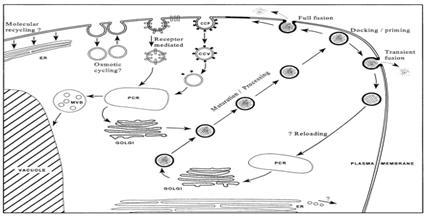
Figure 15: Sequence of Exocytosis and Endocytosis: Transport, Docking, Fusion, Content Release, and Recycling.
Interesting facts:
- Many cells in the body use exocytosis to release enzymes or other proteins that act in other areas of the body like secretion of the hormones glucagon and insulin, or to release molecules that help cells communicate with one another more directly through the products that they secrete like neurotransmitters.
- The immune system also uses exocytosis to communicate information between cells.
- Both endocytosis and exocytosis involve active transport, that is, energy must be expended to move particles against the concentration gradient.
- Both endocytosis and exocytosis involve the formation of vesicles: endocytosis forms them in order to take particles into the cell via the cell membrane and involves a reduction in cell membrane area, as part of the membrane is pinched off to form a vesicle; exocytosis forms them in order to expel things from the cell via the cell membrane and results in an increase in cell membrane, as the vesicle wall joins that of the cell membrane and is incorporated into it. Thus, the two processes also serve to balance each other.
- The vesicle fusion is driven by SNARE proteins process of merging the vesicle membrane with the target one resulting in release of large biomolecules in the extracellular space.
- Ca2+ might control the exocytotic/endocytotic balance in plants.
- Synaptotagmin I (syt1) is required for normal rates of synaptic vesicle endo- and exocytosis.