Macropinocytosis is a different phenomenon from phagocytosis.
Macropinocytosis can uphold for particle uptake and involves the uptake of large amounts of fluid and solutes which is non- specific in nature. The receptors that trigger macropinocytosis have other physiological roles and are present on many cell types. These include growth factor receptors that activate common signalling pathways and involve global activation of the actin cytoskeleton resulting in plasma membrane ruffling and the formation of lamellipodia or blebs over the entire surface of the cell. In contrast, phagocytosis is particle-driven, and it depends on receptor interactions over the entire surface of the ingested particle. The receptors that trigger phagocytosis are usually specialized for interaction with the surface components of relevant cargo particles and actin modifications are localized to the phagocytic cup that forms around the particle.
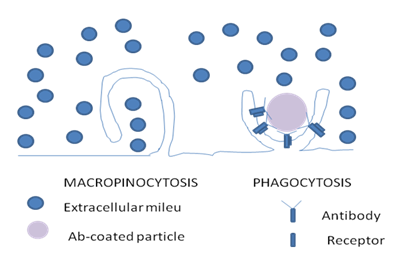
Figure 10: Differences between macropinocytosis and phagocytosis
Protein Trafficking in Endocytosis:
After internalization, clathrin-coated vesicles rapidly shed their coats and fuse with early endosomes which maintain an acidic internal pH and are located in periphery of the cell. This acidic pH leads to the dissociation of many ligands from receptors within early endosome compartment and hence serves as sorting compartment, from which molecules taken up by endocytosis are either recycled to the plasma membrane or transported to lysosomes for degradation. Later, ligands and membrane proteins for degradation are transported to late endosomes which are mediated by movement of large endocytic carrier vesicles along microtubules. The late endosomes are more acidic than early endosomes and fuse with transport vesicles carrying hydrolases from Golgi apparatus. Late endosomes mature into lysosomes when they acquire a full complement of lysosomal enzymes and become acidic. Hence the endocytosed materials are degraded by action of acid hydrolases (Cooper et al., 2000).
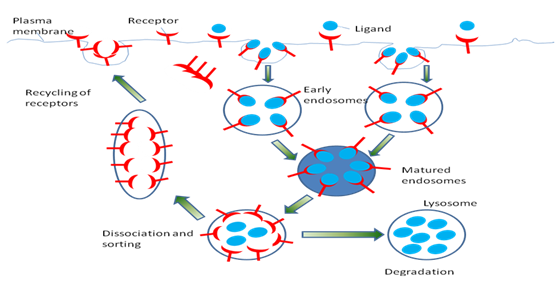
Figure 11: Protein trafficking during endocytosis. The figure shows the recycling of the plasma membrane and degradation of ligands and other membrane proteins in lysosome
The most common example for protein trafficking is recycling of synaptic vesicles. As when an action potential arrives at the terminal of most neuron signals, the fusion of synaptic vesicles with the plasma membrane releases neurotransmitter that carry signal to post synaptic cells. The empty synaptic vesicles are then recovered by plasma membrane in clathrin-coated vesicles, which fuse with early endosomes. The synaptic vesicles are then regenerated directly by budding from endosomes. They accumulate a new supply of neurotransmitter and recycle to the plasma membrane and ready for next cycle of synaptic transmission.