 |
Let the direction of the magnetic field be taken to be z- direction,

we can write the force on the particle to be
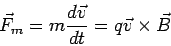
The problem can be looked at qualitatively as follows. We can resolve the motion of the charged particle into two components, one parallel to the magnetic field and the other perpendicular to it. Since the motion parallel to the magnetic field is not affected, the velocity component in the z-direction remains constant.

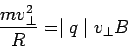
where  is the initial velocity of the particle. Let us denote the velocity component perpendicular to the direction of the magnetic field by is the initial velocity of the particle. Let us denote the velocity component perpendicular to the direction of the magnetic field by  . Since the force (and hence the acceleration) is perpendicular to the direction of velocity, the motion in a plane perpendicular to . Since the force (and hence the acceleration) is perpendicular to the direction of velocity, the motion in a plane perpendicular to  is a circle. The centripetal force necessary to sustain the circular motion is provided by the Lorentz force is a circle. The centripetal force necessary to sustain the circular motion is provided by the Lorentz force
|


