Module 3
:
Electromagnetism
Lecture 13
:
Electric Current and Current Density
Motion in a Magnetic Field - Quantitative
Let the initial velocity of the particle be
. we may take the direction of the component of
perpendicular to
as the
direction, so that
Let the velocity at time
be denoted by
we can express the force equation in terms of its cartesian component
where we have used
and
.
The last equation tells us that no force acts on the particle in the direction in which
acts, so that
1
2
3
4
5
6
7
8
9
10
11
12
13
14
15
16
17
18
19

 . we may take the direction of the component of
  perpendicular to
  as the
  direction, so that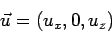
 be denoted by
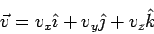
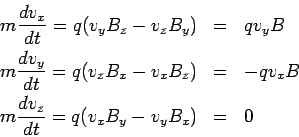
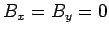 and
and
 .
. acts, so that

