| |
Electric current is the rate of flow of charges in electrical conductor. In a conductor the charges may have random motion. However, the net drift velocity of the charges is zero, giving a zero net current. In the presence of an external force field, the charges move with a net non-zero drift velocity, which gives a current. |
| |
The direction of current has been defined, conventionally, as the direction in which the positive charges move. In case of metallic conductors, the current is caused by flow of negatively charged electrons, whose direction of motion is opposite to the direction of current. In electrolytes, however, the current is due to flow of both positive and negative ions. |
| |
The current density  at a position at a position  is defined as the amount of charge crossing a unit cross-sectional area per unit time. In terms of the net drift velocity of the charges (taken opposite to the net drift velocity of electrons), is defined as the amount of charge crossing a unit cross-sectional area per unit time. In terms of the net drift velocity of the charges (taken opposite to the net drift velocity of electrons),  , ,
|
| |
where  is the volume density of the mobile charges. is the volume density of the mobile charges. |
| |
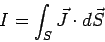
The integral of the current density over a surface defines electric current, which is a scalar. |