|
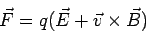
The force on the charged particle in the presence of both electric and magnetic fields is given by
Let the electric and magnetic fields be at right angle to each other, so that,

If the particle is initially at rest no magnetic force acts on the particle. As the electric field exerts a force on the particle, it acquires a velocity in the direction of  . The magnetic force now acts sidewise on the particle. . The magnetic force now acts sidewise on the particle.
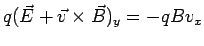
For a quantitative analysis of the motion, let  be taken along the x-direction and be taken along the x-direction and  along z-direction. As there is no component of the force along the z-direction, the velocity of the particle remains zero in this direction. The motion, therefore, takes place in x-y plane.
The equations of motion are along z-direction. As there is no component of the force along the z-direction, the velocity of the particle remains zero in this direction. The motion, therefore, takes place in x-y plane.
The equations of motion are
|