 |
so that  . Differentiating the above equation for . Differentiating the above equation for  , ,
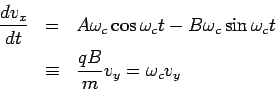
Since  at at  , we have , we have  . Thus, the velocity components at time . Thus, the velocity components at time  are given by are given by
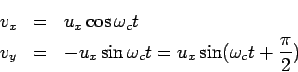
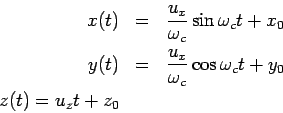
which shows that  and and  vary harmonically with time with the same amplitude but with a phase difference of vary harmonically with time with the same amplitude but with a phase difference of  . Equation of the trajectory may be obtained by integrating the equations for velocity components . Equation of the trajectory may be obtained by integrating the equations for velocity components
|

