| |
We know that an electric field  exerts a force exerts a force  on a charge on a charge  . In the presence of a magnetic field . In the presence of a magnetic field  , a charge , a charge  experiences an additional force experiences an additional force 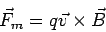
where  is the velocity of the charge. Note that is the velocity of the charge. Note that
- There is no force on a charge at rest.
- A force is exerted on the charge only if there is a component of the magnetic field perpendicular to the direction of the velocity, i.e. the component of the magnetic field parallel to
 does not contribute to does not contribute to  . .
•  , which shows that the magnetic force does not do any work. , which shows that the magnetic force does not do any work.
In the case where both  and and  are present, the force on the charge are present, the force on the charge  is given by is given by
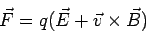
This is called Lorentz force after H.E. Lorentz who postulated the relationship. It may be noted that the force expression is valid even when  and and  are time dependent are time dependent |


