| |
As in the earlier case, we can solve the equations by differentiating one of the equations and substituting the other,
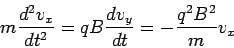
which, as before, has the solution
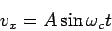
with  . Substituting this solution into the equation for . Substituting this solution into the equation for  , we get , we get
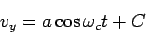
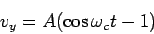
Since  at at  , the constant , the constant  , so that , so that
|


