| which we have already seen in section 3.3. |
|
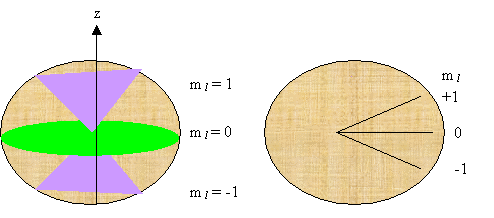
A nice way of visualization of these for l = 1 is given in fig 3.6. This is commonly referred to as space quantization. For l = 0 , the angular momentum = 0 . For l = 1 and ml = 0, the angular momentum is oriented along a radius vector on the sphere such that its projection on the z axis is zero. For l =1 and ml = 1, the angular momentum vector is in the upper cone such that the projection on z axis =  . For l = 1 and ml = -1, the angular momentum is in the lower cone with a projection on z axis = - . For l = 1 and ml = -1, the angular momentum is in the lower cone with a projection on z axis = -  .This implies that all regions of space are not accessible to the .This implies that all regions of space are not accessible to the  vector . Only some regions are accessible and this is turned “space quantization” vector . Only some regions are accessible and this is turned “space quantization” |

 2 is restricted to l(l+1), the rotational Kinetic energy takes on only discrete values as
  2 /2
2 /2
 =
=  2 l (l+1)
  . For a given value of l , ml can take on values
  1,
1,  2 ….
2 ….  l
l  m l
m l 
 , and
, and  in infinitesimal ranges d
 and d
and d is given by
  sin
sin d
d  d
d

