We shall now obtain the energy levels of an object rotating in a plane on a circle of radius r. The operator for the kinetic energy has already been seen in 3.3 to be( - 2 / 2mr 2) 2 / 2 . The eigenvalue equation becomes
- 2 / 2mr 22/2 = E or 2 / 2 = (- 2mr 2 E /2 )
(3.10)
The solutions are once again eimlas in the previous section. = e imlis not permitted as its second derivative will not have the negative sign as in (3), ie 2 /2 e ml = ml 2 .Therefore,
2 / eiml= -ml 2eiml
(3.11)
m l2 = 2 m r 2 E / 2 = 2 I E / 2
or m l = ± (2IE) 1/ 2 / or E = ml22/ 2 I
(3.12)
Due to the “cyclic" boundary condition, ie, () =(+ 2 ), ml has to be an integer, 0, ± 1, ± 2,…………
We have thus seen that the angular momentum as well as rotational energy are quantized. In Bohr‘s theory , m v r = n was a postulate, but in the new quantum theory , this quantization occurs because of the physically reasonable (single valuedness) condition imposed on the wavefunction.
Normalization.
The requirement for normalization is that
* d = 1. In the present case,
o2 e i ml
e -imld= d= 2
(3.13a)
Therefore, the normalized wavefunction for rotational motion in 2 dimensions is ( 2 ) -1/ 2 e i m
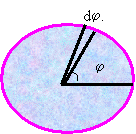
Let us now compute the probability of finding the particle in a range of d for a given angel /.
Figure 3.4: Probability of finding a particle in angle d .
The probability of finding the particle in this range of d is
* d = 1/ 2 e i m e - i m d = d / 2
(3.13b)
which is independent of .This means that the probability of finding the particle in a circular range dis independent of . Since the rotation is “free” (ie in the absence of a potential energy depending on ), this result is to be expected.

 2 / 2mr 2)
  2 /
2 /  2 . The eigenvalue equation becomes
  = E
= E  m l 2 = 2 m r
 = 1. In the present case,
  e i ml