For a particle of mass m moving in a circular orbit or along any other trajectory at the location , the angular momentum is defined as x where = x + y + z , the vector from the center O (the origin of the coordinate system) to the particle and = m is the linear momentum of the particle. The velocity of the particle is given by... = ++ where is the x component of velocity.
Fig 3.1 : Vectors , and x (see below).
The angular momentum is a vector. In the above case it is directed downward from the plane of paper. The three components of the angular momentum vector can be obtained from
(3.1)
where , and are unit vectors and p x, p y and p z are the x, y and z components of linear momentum.
If the potential energy acting on the particle is zero, the total energy E = T + V = p 2 / 2m. The magnitude of = l = pr and we get the following formula for energy.
E = p 2 / 2m = I 2 / 2mr 2 = l 2 / 2 I
( 3.2)
Where I = mr 2 = moment of inertia of the system. One of the issues we want to investigate is whether this angular momentum is quantized (as was assumed by Bohr) and if so, what causes this quantization.

 , the angular momentum is defined as
  x
x  where
where  = x
= x  + y
+ y 
 , the vector from the center O (the origin of the coordinate system) to the particle and
  = m
= m  is the linear momentum of the particle. The velocity of the particle is given by...
  =
= 


 +
+ 
 where
where  is the x component of velocity.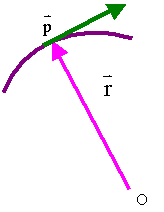
 and
and 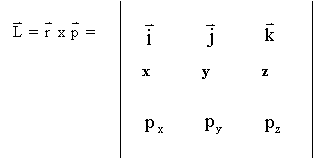
 are unit vectors and p x, p y and p z are the x, y and z components of linear momentum.
  = l = pr and we get the following formula for energy.
