| Rotations on a 3 dimensional sphere. |

|
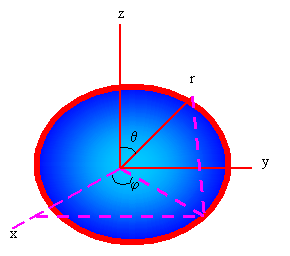
| Figure 3.5 Particle moving on a sphere of radius r. |
In three dimensional rotation on a sphere of radius r, in addition to the angle  , in there is a polar angle , in there is a polar angle  and the wavefunction and the wavefunction is a function of both is a function of both  and and  ie, ( ie, (  , ,  ). The particle is rotating in a field (potential) which is independent of ). The particle is rotating in a field (potential) which is independent of  and and  , ie V = 0, just as in the case of particle in box. The kinetic energy operator is L2 / 2I where L is the angular momentum operator. , ie V = 0, just as in the case of particle in box. The kinetic energy operator is L2 / 2I where L is the angular momentum operator. |
| |
| By using a procedure outlined in section 3.2, the operator L 2 / 2I can be written in terms of  and, and,  as as
|
| |
L 2/ 2I = -  2/ 2I [(1/sin 2 2/ 2I [(1/sin 2 ) )  2/ 2/  2 + (1/sin) 2 + (1/sin)  / /  sin sin  / /  ] = - ( ] = - (  2 / 2I ) ^ 2 2 / 2I ) ^ 2 |
(3.14) |
| Although this appears a lot more threatening than the operator for a particle in box , there is no conceptual difference. The same ideas of separation of variables will be employed. The details of mathematical techniques will be introduced to you in the course on differential equations. |
| |
As is true for any operator the operations must be performed from left to right. Eg, to evaluate the effect of the second term on a function of  , f( , f( ), first take the derivative df( ), first take the derivative df( ) /d ) /d , multiply this by sin , multiply this by sin  on the left and take the derivative of the product, sin on the left and take the derivative of the product, sin  df ( df ( ) /d ) /d  . Divide this further by sin to get the result .Use f ( . Divide this further by sin to get the result .Use f ( ) = 3cos 2 ) = 3cos 2  -1 and perform these operations. -1 and perform these operations. |
| |


