Larger the overpotential, larger the current density j, which measures the number of charges (electrons) transferred at the electrode per unit area per unit time. The anodic and the cathodic current densities (J a and J b ) can be written as
Ja = F Ba exp ( -G#m, a / RT) exp { (1-
) F / RT}
(25.3)
Jc = F Bc exp ( -G#m, c / RT) exp { F / RT}
(25.4)
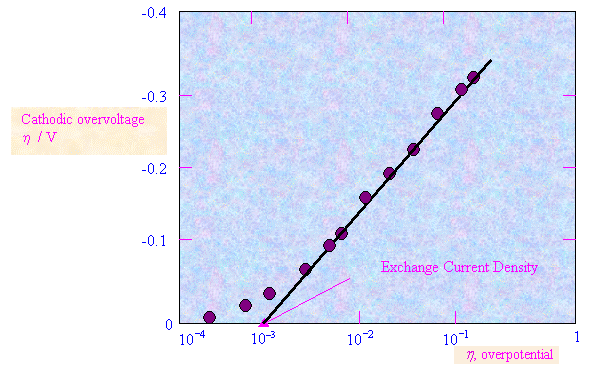
and the net current density J = J a - J c is given by the Butler volmer equation shown below . The value of , the transfer coefficient, is usually ½. Here, F is the Farady constant and G#m, a and G#m, c are the activation energies for the anodic and cathodic current densities respectively. The equations (25.3) and (25.4) indicate that current densities result from activated processes. Free energy of activation and overpotential determine the current densities and our emphasis in this section are not these mathematical expressions but the relation between current density and over voltage (Figure 25.3). The total current density is given by
J = J a – J c = J0 { e (1- ) F/ RT – eF/ RT }
(25.5)
J0 is called the exchange current density and it is the extrapolated value (at either of the electrodes) of Ja or Jb vs when 0. For small over potentials J = J0 F/RT. This shows that current density is proportional to the overpotential for small values of the overpotentials. Dynamic electrochemistry is quite complex and we have given here some of the most basic equations to introduce you to this subject which is of great technological importance. You may refer to reference books for further details.
Figure 25.3 Overpotential vs current density (J/cm -2). This is called the Tafel plot. The process studied is hydrogen evolution on platinum in a 0.1 M hydrocloric acid at 25oc.
The kinetics of corrosion is measured by the corrosion current Icorr . The final expression for the corrosion current is
Icorr = A J0 exp (F / 4RT)
(25.6)
where A and J0 are the geometric means of the areas and the exchange current densities in the anodic and cathodic regions respectively.

 G#m, a / RT) exp { (1-
 ) F
) F  / RT}
/ RT} , the transfer coefficient, is usually ½. Here, F is the Farady constant and
  )
)  F/ RT – e
 when
when  0. For small over potentials J = J0