Module 5 : Electrochemistry
Lecture 25 : Corrosion
  25.1
Introduction

When common metals such as Fe, Cu and Zn are exposed to the environment, the surface of these materials gets deteriorated due to its interaction with the oxygen, moisture and other substances present in the environment. This process is referred to as corrosion. In the case of iron, the process is referred to as rusting. Due to corrosion, the surface of iron gets covered with brownish ferric oxide, Cu gets coated with a green deposit and Zn is covered with a white deposit. About 20% of production of these metals is to make up for the loss of these metals due to corrosion. The need for environmentally friendly technologies to combat corrosion can not be over emphasized.

 
The process of corrosion has an electrochemical (thermodynamic) basis. The surfaces of metals such as Fe, Cu, contain impurities and lattice defects and are reactive when they come in contact with air, moisture, acidic and or basic environments. One part of the surface acts as the anode of a galvanic cell and oxidation that occurs in this part results in the formation of Fe 2+/Cu 2+ ions. These ions go into the solution formed by the condensed water vapour or the acidic / basic fluids which come into contact with this part of the surface. The electrons released in this oxidation Fe Fe 2+ + 2e, Cu Cu 2+ + 2e easily travel through the conducting medium of the metal until they come into contact with H+ of an acidic neighborhood or O2/H2O in a neutral or basic neighborhood and react with them. The reactions involved in these reduction processes are


Table 25.1 : Reduction reactions involved in corrosion

 Reaction

 Nature of the solution

 Eo / V

 H + + e 1/ 2 H 2 (g)

 acidic

 0

 O 2 + 4H+ + 4e 2H 2 O

 Acidic

 1.23

 O 2 + 2H 2 O + 4e 4OH -

 Neutral / basic

 0.40

 
The movement/migrations of ions in the surrounding medium completes the “circuit” consisting of production of cations, electron flow (inside the metallic medium) and ionic movement.
 

The extent and the rate of corrosion depends on the presence of active sites (usually “rough” surfaces) on the metallic surface and the availability of O2 on the metallic surface (for the cathodic reduction). Sharp or pointed ends of the metal are known to act as anodic sites. The oxidation and reduction sites can be demonstrated by the use of suitable indicators on the metallic surfaces. When a metal is in contact with another (a second metal) whose oxidation potential is greater, the second metal gets oxidized in preference to the first. Even if different parts of a metal are exposed to different concentrations/pressures of O2, the oxidation of the metal occurs in regions of lower concentrations of oxygen.

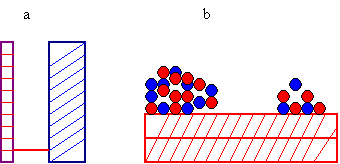
Fig 25.1 a) Two metals in contact, b) Differnt concentrations of O2 at different regions of the surface.

Some of these aspects will be elaborated and incorporated in the methods for preventing corrosion.