Module 5 : Electrochemistry
Lecture 25 : Corrosion
 

c) Cathodic Protection:

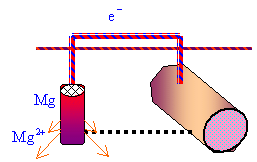
In this method, corrosion of a metal is prevented by a constant supply of electrons and the reduction of oxygen is carried out by electrons provided by a sacrificial anode. E.g., magnesium whose reduction potential is –2.36 V. When a Mg rod is connected to Fe, Mg gets oxidized to Mg2+ without affecting Fe. Although Mg is more expensive than Fe, it is used as a sacrificial anode in ships, buildings, etc which are more “valuable” than the loss caused by the corrosion of the sacrificial anode.


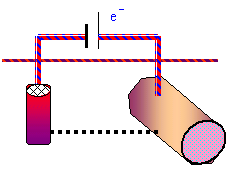
Figure 25.6 a) Cathodic protection by sacrificial cathode, b) Cathodic protection by impressed current


d) Cathodic protection by impressed current :

If the surface of the metal is kept at a more negative potential than the equilibrium value by impressing a current at its surface by a DC supply, then, the electrons required for reducing the O2 of surrounding air or water are supplied by this generator or rectifier, preventing Fe from going into solution as Fe2+. For this purpose, current is supplied to the Fe metal by inert anodes mounted on the surface. The choice between methods (c) and (d) is determined by costs and maneuverability. In food processing wherein contamination by sacrificial anode can not be tolerated, and in ocean going ships and pipe-lines, impressed current protection is favoured over cathodic protection.