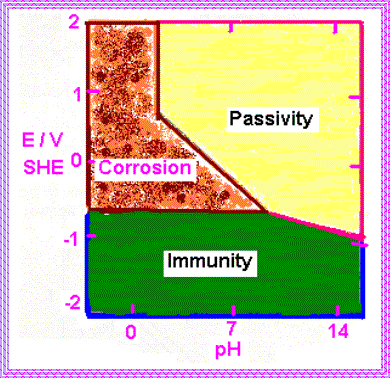
In the region enclosed by the green lines corresponding to reaction 1 (lower dotted line) and reaction 2 (upper dotted line), water is stable. For a combination of pH and potential above the top dotted line, water decomposes evolving oxygen. Below the lower dotted line water decomposes by evolving H2. A widely accepted convention is that a metal is considered to corrode if the activities of ions derived from it (e.g., aFe3+, aFe2+) exceed 10-6. If the ionic activities/concentrations are less than 10-6, it is considered to be passive. If the ionic concentrations are greater than 10 - 6 and the reaction rates are reasonably fast, these regions correspond to the domain of corrosion. The region of the Pourbaix diagram, wherein the metal can be protected (if the stable species is an insoluble solid which can be made to form an impervious adherent layer covering the metal), it is considered to be immune. The regions of immunity, passivity and corrosivity are shown in fig 25.2c. The limitations of these diagrams are that they do not have any kinetic information, they use an arbitrary value of activity for identifying passivity and that they do not take into account reactions induced or modified by impurities and alloys. |