Consider a redox reaction between Zn(s) and copper ions shown below
Zn(s) + Cu2+ (aq) Cu(s) + Zn2+ (aq)
(22.1)
Counterions are of course present in the solution but are not shown because they do not participate in the reaction. The above reaction is spontaneous. If pieces of Zn metal are added to a CuSO4 solution, Cu(s) starts depositing on the Zn pieces. To get useful electrical work from such a process, it is best to place the Cu and Zn rods(electrodes) in separate compartments as indicated below.
Fig 21.1 A schematic view of a Daniell cell.
The left compartment consists of a zinc rod dipped in a solution containing Zn2+ ions (such as zinc sulphate) and the right compartment consists of a copper rod dipped in a solution containing Cu2+ ions (e.g., CuSO4 solution). The external circuit is completed by a wire of known resistance (for producing heat, light or other forms of work). The contact between the solutions is provided by a salt bridge containing saturated KCl or NH4NO3 solution along with gelatin or agar for confining the electrolyte in the tube. The salt bridge prevents mixing of the electrolytes, allows the flow of ions and reduces polarization near the electrodes. Electrons flow from the Zn electrode to the Cu electrode in the external circuit, or the positive charge flows from the Cu electrode to the Zn electrode. If this cell were to operate as a battery, the Cu electrode would be the positive terminal of the battery.
For the reaction (22.1), rGo = - 212.9 kJ / mol and this energy is made available as the electrical energy in the external circuit.

 Cu(s) + Zn2+ (aq)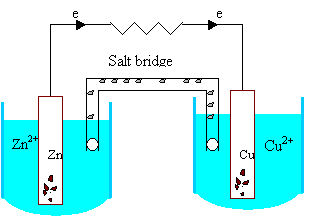
 rGo = - 212.9 kJ / mol and this energy is made available as the electrical energy in the external circuit.
