Module 5 : Electrochemistry
Lecture 22 : Free energy and EMF
  22.1
Introduction
Both electrolytic cells and galvanic cells provide wonderful examples of conversion of one form of energy into another. In an electrolytic cell, a current is passed through a fluid medium (solutions, molten salts) causing migration of ions towards electrodes and the charge deposition by the ions at the electrodes. For example, if a current is passed through a solution of sodium chloride, the following reactions occur at the cathode and anode.
  
Cathode: Na + + e Na, reduction; The cathode is connected to the – ve terminal of the battery or cell that is causing electrolysis.
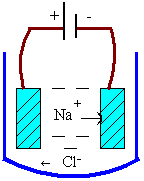
Anode: Cl - ½ Cl2 + e, oxidation; The anode is connected to the + ve terminal of the cell or battery (see Fig 22.1).


The complete reaction may be written as

Na + + Cl - Na(s) + ½ Cl2 (g)

Figure 22.1: An electrolytic cell showing the migration of cations and anions.


In a galvanic cell on the other hand, the two electrodes are present in differing chemical environments with different chemical potentials / free energies. We have already seen in the earlier chapter that a decrease in the Gibbs free energy is equal to the maximum non pressure volume work obtainable from the system.

r Go = - n Fo


The net free energy difference between the electrodes forces the current to flow in the external circuit (wires connecting the electrodes). At the electrode (anode) with the greater reduction potential, reduction (gain of electrons) occurs. At the electrode which has a lower reduction potential (cathode), oxidation (loss of electrons) occurs and the electrons move from anode to cathode in the external circuit.