If  is the pumping induced transition rate for is the pumping induced transition rate for  or or  and and  is the natural lifetime of atoms in the upper level, the rate equation for the two levels may be written as follows : is the natural lifetime of atoms in the upper level, the rate equation for the two levels may be written as follows :
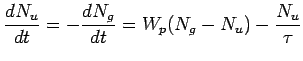
where  . In the steady state, the time derivatives vanish, and we have . In the steady state, the time derivatives vanish, and we have
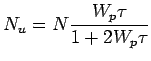
In order that a population inversion may take place, we must have  . However, one sees that as the intensity is increased the population in the upper level at best approaches this number as its maximum. Thus population inversion is not possible in a two level system. . However, one sees that as the intensity is increased the population in the upper level at best approaches this number as its maximum. Thus population inversion is not possible in a two level system.
|


 by an external source of energy ( such as by an electric pulse or by optical illumination).
