If  , there will be more population in the upper laser level than in the lower one, leading to a population inversion. Using the above, and after straight forward simplification, we get , there will be more population in the upper laser level than in the lower one, leading to a population inversion. Using the above, and after straight forward simplification, we get
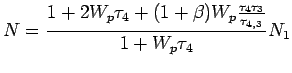
and the population difference 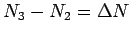 given by given by
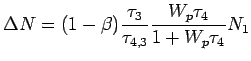
Combining the above two equations
![$\displaystyle \boxed{\frac{\Delta N}{N} = \frac{(1-\beta)W_p\frac{\tau_3\tau_4}... ...+\beta)+ 2\frac{\tau_{4,3}}{\tau_3}\right]W_p\frac{\tau_4\tau_3} {\tau_{4,3}}}}$](../../fig/math-images/math_clip_image031_0000.gif)
Let us define Quantum Efficiency  as the fraction of atoms excited from the ground state (1) which ultimately results in stimulated emission. as the fraction of atoms excited from the ground state (1) which ultimately results in stimulated emission.  is thus a product of the fraction which arrives at the upper laser level (3) and the fraction of atoms in the upper laser level which make radiative transition to the lower laser level (2). is thus a product of the fraction which arrives at the upper laser level (3) and the fraction of atoms in the upper laser level which make radiative transition to the lower laser level (2). |


