If now, an active medium with a gain coefficient is put inside the Fabry-Perot cavity, in one round trip the optical power is
Optical amplification occurs if , i.e., if
The righthand side of the above is termed threshold gain .
2.12
Gain Saturation:
Clearly, gain cannot continue indefinitely. For each photon added to the field, one atom is removed from the upper laser level and one is added to the lower level. Thus population inversion reduces, which in turn, reduces gain. There is a competition between pumping and stimulated emission rate. Pumping builds up population of the upper level till threshold is reached and stimulated emission starts.
Let us consider a simple rate equation for the population of the upper level. Let be the number density of photons per unit time. In a gain medium . The population of the upper level is given by
where, is the pumping rate to the upper level, is the natural lifetime of the excited atoms and is the gain cross section.

 is put inside the Fabry-Perot cavity, in one round trip the optical power
  is
is 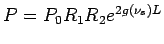
 , i.e., if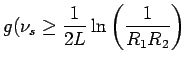
 .
.  be the number density of photons per unit time. In a gain medium
 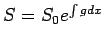 . The population of the upper level is given by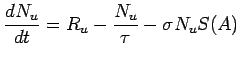
 is the pumping rate to the upper level,
  is the natural lifetime of the excited atoms and
  is the gain cross section.
