 |
The intensity pattern which is given by the square of  is shown. Though there is no unique way of defining the frequency spread, we note that the first zero of the intensity pattern occurs at is shown. Though there is no unique way of defining the frequency spread, we note that the first zero of the intensity pattern occurs at 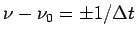 . Thus one can define the spread of frequency to be given by . Thus one can define the spread of frequency to be given by  . This is simply a statement of the classical uncertainty principle connecting the band width to coherence time . This is simply a statement of the classical uncertainty principle connecting the band width to coherence time  , ,

|


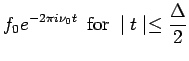

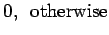


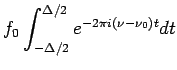

![$\displaystyle f_0\Delta t \left[\frac{\sin\pi(\nu-\nu_0)\Delta t}{\pi(\nu-\nu_0)\Delta t} \right]$](../../fig/math-images/math_clip_image109.gif)

