In the presence of light, the steady state solution to equation (A) is obtained by equating the right hand side of (A) to zero. The steady state population of the upper level is given by
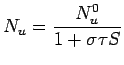
We may rewrite the above as
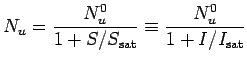
where  is the saturation intensity, which is equal to the intensity for which the gain is reduced by a factor of 2. is the saturation intensity, which is equal to the intensity for which the gain is reduced by a factor of 2. |


 after which the phase correlation between two waves which were initially in phase ( or between two points in the same wave which had a known phase difference) drops significantly.
  seconds so thata wave which seems continuous, actually consists of a sequence of waves which are typically
  m long which no phase correlation between parts of one wave train and another.
