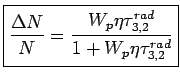
Fraction of atoms in level 4 which arrive at level 3 is given by the ratio  and the fraction of atoms in level 3 which radiatively make a transition to level 2 is and the fraction of atoms in level 3 which radiatively make a transition to level 2 is  . We have used a superscript rad to indicate that only the radiative component of the transition from 3 to 2 is considered. Thus . We have used a superscript rad to indicate that only the radiative component of the transition from 3 to 2 is considered. Thus
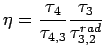
Substituting this in the previous equation, we get, for 
![$\displaystyle \boxed{\frac{\Delta N}{N} = \frac{(1-\beta)W_p\eta\tau_{3,2}^{rad... ...+ \left[ (1+\beta)+ 2\frac{\tau_{4,3}}{\tau_3}\right]W_p\eta\tau_{3,2}^{rad} }}$](../../fig/math-images/math_clip_image037_0000.gif)
To ensure that most of the atoms excited by pumping participate in laser transition, the life time in the level 3 must be the longest. Using  , we may ignore this term in the denominator of the above. Further, , we may ignore this term in the denominator of the above. Further,  . Using these, one can see that . Using these, one can see that  is small and approaches zero. is small and approaches zero. |

 ramains positive and population inversion occurs even for very small pumping power. For
  , the expression for
  is given by