In 1550nm window, the pulse broadening due to dispersion takes place because the shorter wavelengths travel faster and the longer wavelengths travel slower.
If a device can delay the shorter wavelengths compared to the longer wavelengths, dispersion compensation can be achieved.
In principle this can be done by the chirped FBG.
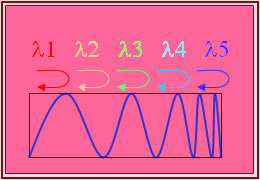
Inside the chirped FBG different wavelengths get reflected from different location on the FBG. The wavelength is reflected when it is approximately equal to the Bragg wavelength. Since on a chirped FBG the spatial period and consequently the Bragg wavelength is different at different locations, different wavelengths get reflected from different locations on the FBG.
A dispersion compensating FBG at 1550nm band would be as shown in Fig
Here the FBG spatial period increases from input to output and we have
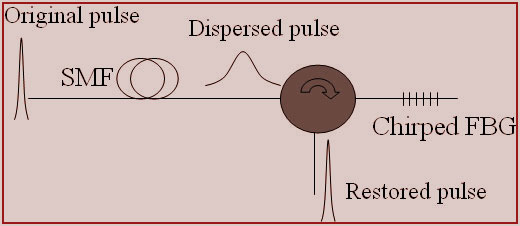
A few mm of the chirped FBG can compensate the dispersion caused by tens of Km of normal SM fiber.
A schematic of dispersion compensating scheme is shown in Fig.


 and consequently the Bragg wavelength is different at different locations, different wavelengths get reflected from different locations on the FBG.